You Have Been Warned.
What do you know about Klamath River water issues? Do you know where the Klamath River is?
Do you know its history? Have you hear about the Water War of 2001?
Have you heard about the Water Situation of 2010?
What I am going to write will upset many humans and please others.
Will I be writing about fish versus potatoes… Indians versus farmers… environmentalists versus natural resource producers… guilt greens versus money greens… reds versus blues… black versus white versus shades of grey…? The answer is none of the above.
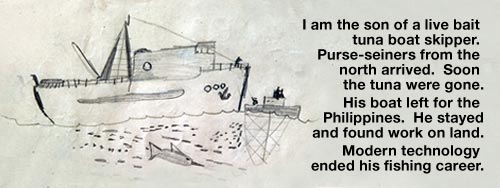
I did this drawing when I was 5 years old. My dad's tuna clipper, with a crew of twelve, could be gone for nine months and return with 120 tons of tuna. The giant fish were caught by poles with men in ocean racks off the stern. At times, three poles were connected to one line.
I am writing about human nature. And today, the drama of human nature escalates in what many know, erroneously, as the Klamath Basin crisis but which is really humans manipulating-managing Klamath River Watershed resources.
Invisible Elephants in a Porcelain Forest.
Populations! There are humans worried about the Coho salmon population. There are humans worried about the Sucker fish populations. There are humans worried about the Spotted Owl. There are some humans, usually living faraway, who worry about all of these populations. There are humans who are worried about a growing number of wildlife populations yet to make the endangered headlines. And, there are humans worried about their families, towns and ways of life..
But there is one population that goes largely unnoticed, the human population.
Without humans would there be population problems? Ask the tree falling from old age, storms, fire, ice drought or flood or… Would this tree make a sound without humans? The human is a by-product of wildlife extinction. This is not a new phenomenon. Meteorites strike the earth, super volcanos explode, ice ages come and go, predators wipe out their food supplies and perish… And on and on as our little planet, spinning in an expanding universe, hurdles through a space whose ever-increasing scale defies human comprehension.
In my lifetime the global population has doubled. Around the world one billion human are hungry and do not have access to clean water. In the United States, hospitals, schools, prisons, unemployment lines, and bankruptcy courts are overwhelmed by the masses. Addictions are increasing, kids are unhealthy, teens unsatisfied, food production challenged, and transportation- water-power delivery systems are stressed by population pressure. Cities, counties, states and the Federal government find it difficult to cover expenses. Most people would agree this is reality, it is not good and changes need to be made. They feel constraints. They see their expectations not being met. Parents realize that their children’s futures may not offer the same opportunities they had. So what are we going to do about it? Effective change begins with understanding your own watershed, not somewhere else. Rebuild the future one neighborhood’s watershed at a time.
An Unspoken Truth that Echoes Across All Habitats.

It is not fun to point a finger in another's face but when the times are necessary...
Now, here is what I have to say that many folks will not like to hear. Our economy is based on the simple premise that a increasing population, an ever-expanding consumer base, will float all boats: luxury yachts, aircraft carriers and dinghies. Tomorrow will pay for today. And so goes the human condition. And so goes the human population. We now find that today is not paying for yesterday. Some may feel that this is an unpatriotic sentiment. I argue that an expanding human population without hope poses the greatest threat to national security. This is not about government, or governments, this is about individual choices humans make. I will use less power. I will maximize my water consumption. I will eat replaceable food. I will have less children. I believe modern humans subconsciously understand population issues confront, and effect, them everywhere they go. We do know this, but…
In days of old if it became to crowded, one cross an ocean and find a new frontier.
Where do we go today? And the answer isn’t space. At the moment, we only have beds for six people orbiting earth. And what does all of this have to do with Coho salmon? It has everything to do with it.
Coho salmon populations, suckers populations, human populations… Which population has the greatest impact on the other populations? Which population needs the most help to be able to help other populations? Ask yourself a simple question, what will your neighborhood be like in twenty years? Sooner, or later, human population will be become a political issue.

This is a t-shirt that I designed in 2000 for the Bald Eagle Conference. It is now called the Winter Wings Festival. It seems folks grew weary of the Bald Eagle recovery effort.
Speaking of economies, the humans who create crisis are the humans who make money “fixing” the crisis. This leads to unintended consequences in the name of saving mother nature. Over time the greatest motivation becomes not species protection, it becomes job creation and job security in search of benevolent retirements. If you think planet Earth really cares what happens to humans try finding a dinosaur to fill out your Wednesday night poker game!
©2010 Anders Tomlinson, all rights reserved.
Next installment: Those Who Create Crisis Create Crisis.