Millions of visitors come each year to a land of harvests and growing families.
Tulelake, Tule Lake, Tule Lake Basin… you say potato, I say grebe, you say coyote, I say horseradish, you say harriers, i say cattle, you say pelicans, I say grain, you say mint, I say osprey, you say antelope, I say alfalfa and on and on and on… here is the nature of reclaimed lake bed used by farmers, wildlife and nature watchers. This land is alive in many more ways than controversial media sound bites and headlines you may have seen and heard.
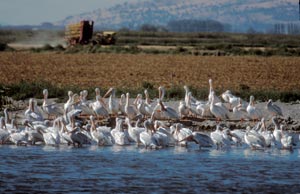
Pelicans rest on the bank of a flooded field as farm equipment passes by. photo-Anders Tomlinson
Delivering water to soil that was once a lake bed.
Tule Lake Basin is crisscrossed by Tulelake Irrigation District’s 600 miles of canals- that’s 1,200 miles of shoreline. Water is moved back and forth from farm fields to drains, back to farms, or the lake or U.S. Fish and Wildlife projects. Today, the amount of water used in a year could be less than what naturally evaporated from old Tule Lake. Seasons dance under passing clouds and deep blue skies. A Year in the Life through photos and words.
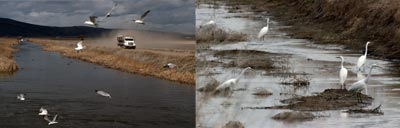
Around the year, if there is water in irrigation canals there is wildlife.
photo-AndersTomlinson
A modern relationship between man and migrating waterfowl.
I have had people tell me that other people have told them that Tule Lake National Wildlife Refuge is too geometric with all the rectangular farm fields. Everywhere there are right angles, so unnatural for wildlife. I laugh. I wonder where those people live. The chances are their homes were built on land that was once wildlife habitat. It is also possible the land was graded and plated into grids. And in Southern California the lush landscaping, fueled by borrowed water, strived to break up the squares. How can these folks look at wildlife thriving in Tule Lake Basin and say their Tule lifestyle is unbecoming?
Wildlife takes advantage of everything it is aware of. It has been said what is good for the goose is good for the gander. Can it be said what is good for man is good for geese? Or what is good for geese is good for man? There are few habitats left that migrating waterfowl can use. Places like Tulelake are all that these migrations have. Wildlife use Tulelake refuge and farmland to survive.
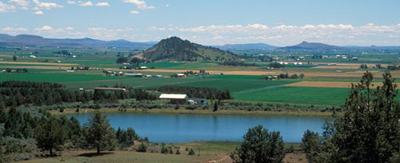
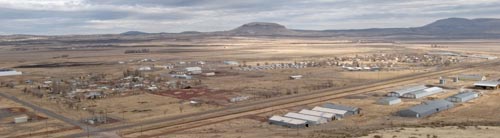
Looking south from hills behind Merrill and Malin, Oregon.
photo-Anders Tomlinson
Mother nature does what she does.
The springs of 2007 and 2008 in the Upper Klamath Basin were wet. Relatively undeveloped refuge such as Upper Klamath Lake and Klamath Marsh National Wildlife Refuges had so much water there was no where for birds to put nests. Nests were being built on canal fed Tule and Lower National Wildlife Refuges. Man’s ability to manage water levels provided wildlife with safe nesting areas. Free flowing nature can be a killer, as well as a provider. Despite man’s researched predictions, whatever the research intentions may be, the world doesn’t always follow projected mathematical models. The story of Tulelake is both ancient and modern. It is a story of accommodation and cooperation. One needs to visit, linger, listen and watch with willing and open eyes. The future of man and wildlife plays out before you.
©2010 Anders Tomlinson, all rights reserved.